Forty
Today, I turned forty. It happened at exactly 8:31 A.M., as my mother likes to remind me each year. My sense of order is disrupted by the time. Could it not have been a minute sooner? I like to think the doctor’s watch was running a minute fast. Perhaps after forty years I should have learned to let go of such irrelevant minutiae.
The history of my life isn’t yet written, but I constantly forget this. I mistook the strength of youth for the value of life. But youth is an aberration — a brief window of surplus capacity — a sideshow that we’ve built an entire culture around mistaking for the main event. The things that actually matter — judgment, depth, presence, the ability to stretch a musical phrase past the point of dissolution — those aren’t youth’s gifts. Those come later, if we’re lucky enough.
Perhaps what we fear most isn’t age, but irrelevance. Luckily, relevance isn’t about capacity. It’s about having something to say, and the courage to say it.
So: cultivate what progress cannot obsolete.
Some men, given this advice, buy sports cars. Nerds, given this advice, buy useless rare Macs.
The sports car is a confession. It announces, with German engineering and a sixty-month payment plan, that something needs to be felt before it’s too late. Speed as a hedge against irrelevance. A 4,000-pound dating profile. The midlife crisis has a body kit, gets eight miles per gallon, and everyone — including the man behind the wheel — knows exactly what it’s for.
I should disclose, before going further, that I drive a German car. I have a car-shaped hole in my heart mostly filled with repair bills. So whatever follows is not a sermon delivered from the pulpit of moral superiority; it is a sermon delivered from the driver’s seat of a vehicle that is, at this moment, probably leaking something expensive onto my driveway. I am not the sober alternative to the midlife crisis. I bought the car and the useless rare Mac, which means whatever follows should be read less as critique and more as a man trying, in real time, to figure out which of his coping mechanisms is the least embarrassing.
The rare Mac is also a confession. It just doesn’t photograph well at the country club.
Let us begin with the basic accounting. The sports car guy buys an object that, whatever else you want to say about it, goes. It accelerates. It performs the function it was designed to perform, and performs it, by most accounts, well. He can drive it to the grocery store. He can drive it to his daughter’s wedding. He can, in extremis, drive it away from his problems, which is more than can be said for most coping mechanisms — and which is more than can be said for my car, which has 100,000 miles on it and is, at this moment, at the dealership for reasons the service advisor described to me using the phrase “well, where do I start?”
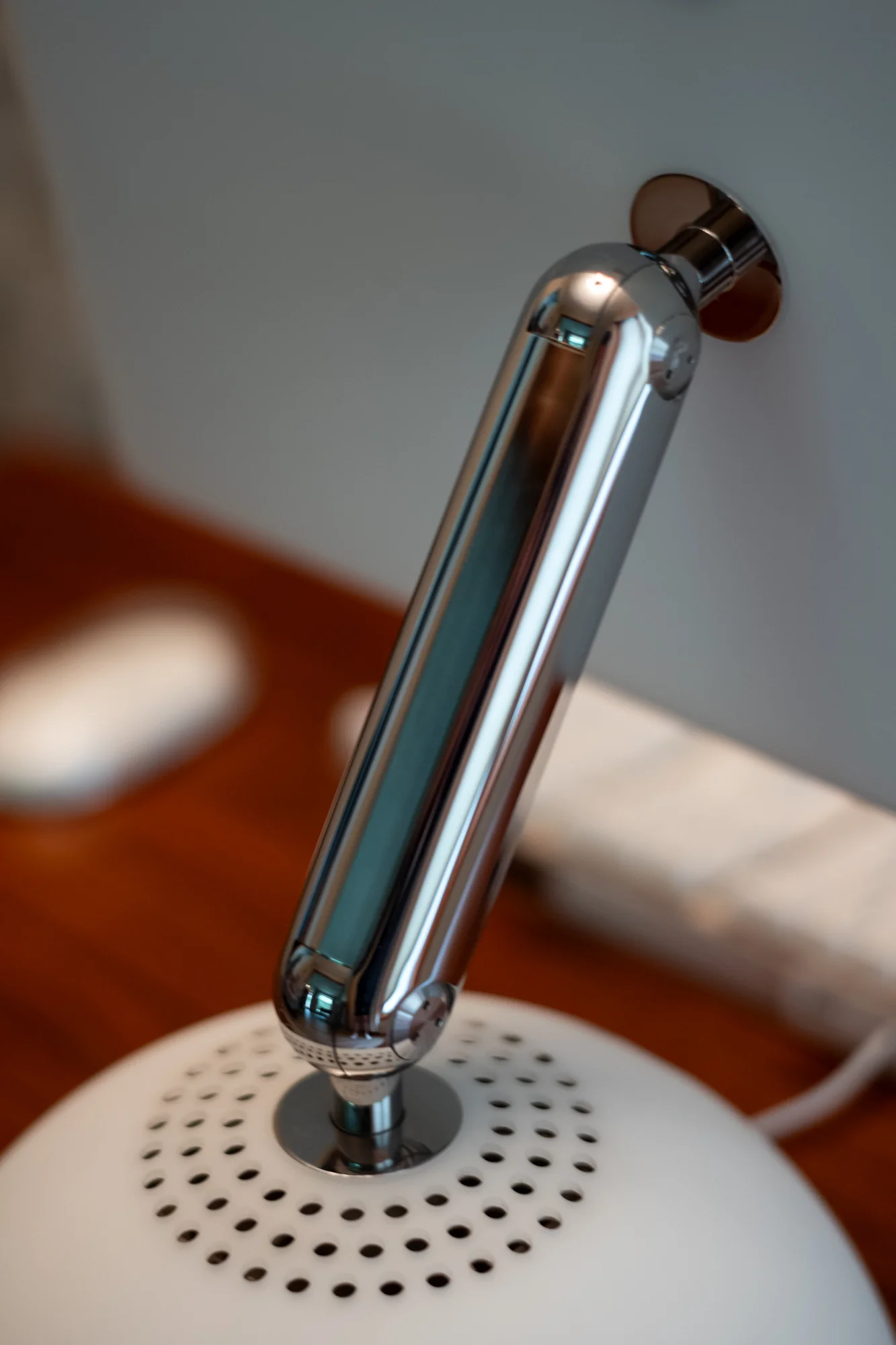
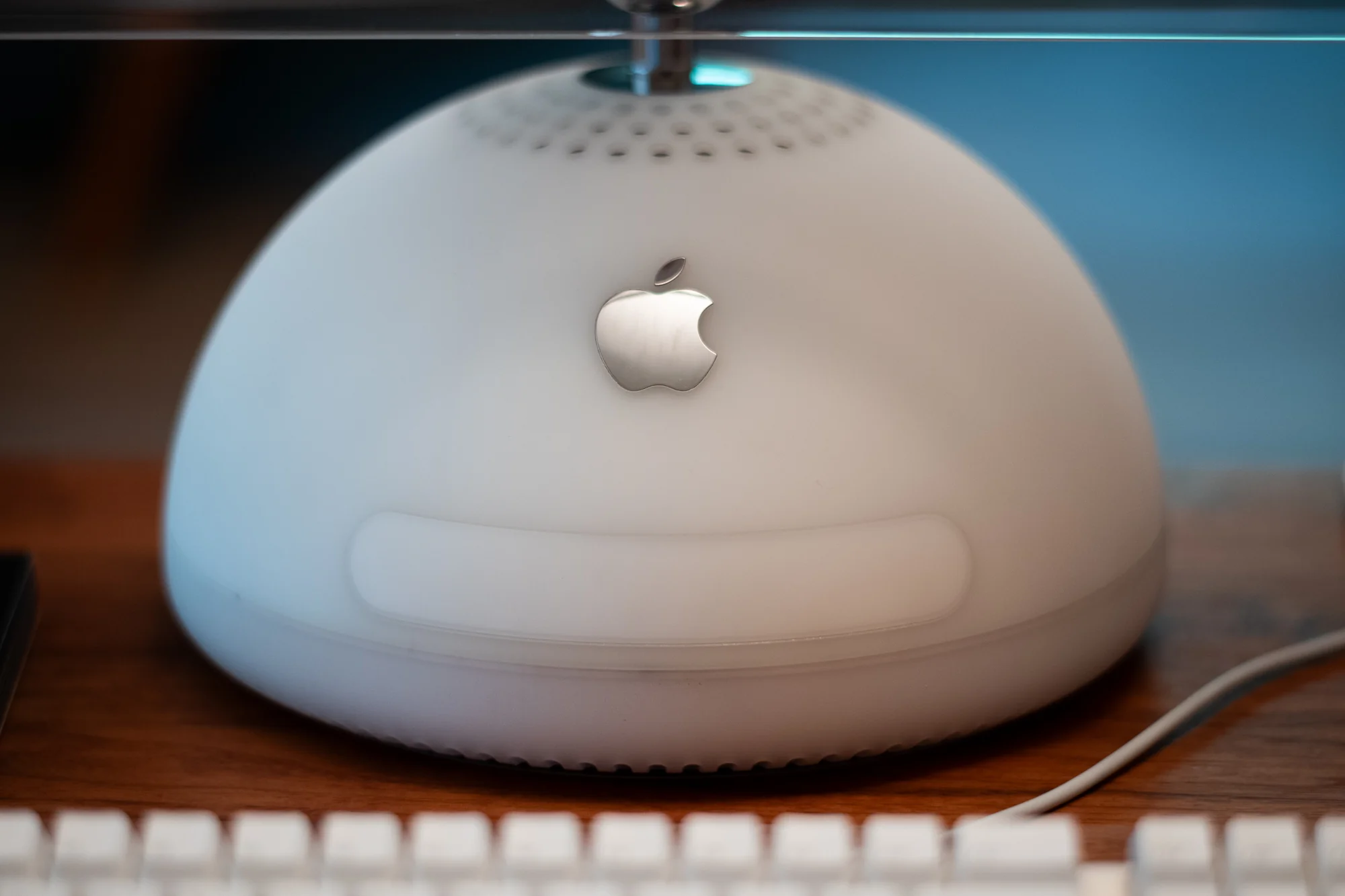
I bought a 2003 iMac G4. It runs an operating system that predates the iPhone. It cannot open my email. It cannot load my own website. It weighs forty-some pounds and the only place it goes is from the box it came in to the desk it now sits on, where it will remain, by the laws of physics and inertia, until I die or move, whichever comes first. The sports car guy at least gets to use his midlife crisis. Mine just sits there, glowing faintly, judging me. The car, for what it’s worth, is doing the same thing from the garage.
Nobody buys a 2003 iMac in 2026 because they need a computer. There are faster machines in the recycling bin behind any office building. The G4 on my desk runs Tiger, cannot load any website built after roughly 2014, weighs more than my dog, and once asked me — through the dignified medium of a fan ramping up to jet-engine — to please reconsider opening a third Safari tab. By every metric that matters to a procurement department, it is useless. That’s the point. That is exactly the point, and the more useless it is the more correct it is, which is the kind of sentence you can only write if you have already lost the argument and decided to enjoy yourself.
The sports car driver is buying a feeling he’s afraid he’s losing. The Mac collector is buying a feeling he’s afraid the world is losing — which is, admittedly, the more pretentious framing of the two, but only barely. The sports car guy thinks he’s going to drive his Boxster up the Pacific Coast Highway with his hair (such as it still exists) blowing romantically in the wind. The Mac guy thinks he’s preserving a fragile cultural inheritance against the encroaching beigeness of a world optimized by committee. Both of these men are lying to themselves. I, having purchased both, am lying to myself in stereo. The sports car guy is at least lying to himself in a way that other people might find appealing.
It gets, somehow, worse. Last weekend I decided the G4 needed an app. Not a useful app — there is no useful app you can write for a 2003 iMac in 2026, because the useful apps require frameworks that did not exist when this machine was manufactured and will not run on the operating system it is capable of booting. I decided it needed a specific app, a small thing to track the books I read on it, written natively, in Objective-C, against an SDK that Apple has spent the last decade gently trying to euthanize without anyone noticing.
I want to be clear about what this means. It means I sat down, on a Saturday, in the year 2026, and wrote square-bracket message-passing syntax — [object doSomething:withThing:andAlso:] — into Xcode 2, which I had to install from a disc image I found on a forum, to compile a binary that runs on exactly one computer in the world, mine, in a home office in Omaha, where nobody will ever see it or use it or benefit from its existence in any way. The sports car guy, meanwhile, was at brunch. My car, meanwhile, was at the dealership. Everyone was somewhere. I was in Xcode.
Modern software development is, whatever its other sins, social. You write code other people will read. You use frameworks other people maintain. You ship to users who, in theory, exist. I wrote an Objective-C app for a dead machine in a dead dialect, and the only code review it will ever receive is from me, six months from now, when I open the project file and think who wrote this and why are they like this. The answer, in both cases, will be me.
There is a name for this, in the literature. It is called a hobby. The literature is being generous.
Most objects produced today have no argument. They have features. They have spec sheets. They have a quarterly earnings call to satisfy, a supply chain to optimize, a focus group that flinched at anything too distinctive, and a designer who was told, in so many words, to make it look “premium” — a word that means nothing and is therefore extremely useful in meetings. The result is the visual equivalent of corporate communication: technically correct, structurally sound, saying nothing.
The G4 said something. Twenty-some years later it is still saying it: the screen should float, the compute should hide, the machine should not apologize for being a machine but it should not brag either. It should be the most graceful possible solution to the problem of needing a computer in a room with humans in it. You can disagree with the argument. You cannot accuse it of not having one — which is more than can be said for the average 2026 product launch, where the argument is “we used a slightly lighter aluminum and the bezels are smaller, please clap.”
There is also — and this is the part the sports car guys have a harder time admitting — something monastic about the rare-Mac purchase. The car broadcasts. The Mac sits in an upstairs office where almost no one will ever see it. The audience is one person. The pleasure is private. It is closer to buying a fountain pen, or a film camera, or a piano you will never play in front of anyone — and yes, I own all of those things, and yes, I know what that means, and yes, I’m writing this on a typewriter that is older than I am, on a desk next to a computer that doesn’t work, in a room nobody is ever going to see. The sports car guy is going through a phase. I have constructed an entire interior life around the phase, monetized none of it, and called it a personality.
The economics make no sense and the economics are not the point. The object exists to remind its owner, every morning, that he once decided what he loved and has not yet been bullied out of loving it. The sports car says I refuse to grow old. The rare Mac says I refuse to forget. The German car in my driveway says please, for the love of God, stop driving me until you’ve called the dealership. The first is a lie you tell yourself at a stoplight. The second is a lie you tell yourself in the office at one in the morning, illuminated by a CRT, while a typewriter you have not yet figured out how to ribbon stares at you accusingly from across the room. The third is just a check engine light.
A sports car is a protest against death. A rare Mac is a protest against forgetting. A German sedan with 100,000 miles on it is a protest against having a savings account. The first is louder. The second lasts longer. The third is, by a considerable margin, the most expensive. The first makes a kind of sense to anyone who has ever been forty and afraid. The second only makes sense to me, possibly fourteen other people, and the search engine that will eventually index this post and conclude, not unreasonably, that it has been written by a malfunctioning AI.
The sports car guy will sell his car in three years and buy a slightly less embarrassing one. I will still be here, dusting the G4.